How Much Does a Kitchen Sink Cost? Prices by Material
How much does a kitchen sink cost depends on material, mount style, and whether you hire a pro or tackle it yourself. A basic drop-in stainless unit starts around $80 while a hand-hammered copper farmhouse can top $2,500 before labor. Most homeowners spend between $350 and $1,200 for a quality mid-range sink installed.
Your countertop choice often dictates which mount types are even possible.
Manufacturer specifications list 18-gauge stainless as the sweet spot for durability and value. The NKBA recommends a minimum 36-inch base cabinet for standard double-bowl configurations. Let's break down what drives each price tier so you can match the sink to your remodel budget.
Quick Answer
A kitchen sink costs $80 to $2,500 for the fixture alone. Installation adds $200 to $600. Most buyers pay $350 to $1,200 total for a mid-range undermount stainless or composite sink.
Prices vary by material, gauge, and mount type.

What You're Actually Paying For: Kitchen Sink Cost Breakdown
The sink itself is only part of the invoice. Labor, countertop modification, and accessories shift the final number fast.
Sink fixture, $80 to $2,500+. Material and brand set the baseline. Stainless runs cheapest.
Fireclay and copper sit at the top.
Professional installation, $200 to $600. Undermount and farmhouse mounts need precise countertop cuts and heavy lifting. Drop-in installs take half the time.
Countertop cutout, $100 to $300. Fabricators charge extra if the sink template arrives after the slab is cut. Order the sink first.
Faucet and accessories, $150 to $600+. Holes must match your faucet config. Garbage disposal flanges and air gaps add up.
Cabinet reinforcement, $50 to $200. Fireclay and cast iron sinks weigh 100 to 200 pounds. Standard particleboard floors sag without plywood backing.
| Cost Component | Low End | High End |
|---|---|---|
| Sink only | $80 | $2,500 |
| Pro install | $200 | $600 |
| Countertop cutout | $100 | $300 |
| Faucet + disposal | $150 | $600 |
| Cabinet prep | $0 | $200 |
Sink Types Compared: Drop-In, Undermount, Farmhouse, and Workstation
Mount style changes the look, the install difficulty, and the countertop materials you can use.
Drop-In (Top-Mount)
The rim sits on top of the countertop. Clips underneath hold it tight. Silicone seals the edge.
Works with laminate, tile, wood, stone, any surface. Easiest DIY swap. The lip traps crumbs and makes wiping debris into the bowl harder.
Budget models start at $80. Premium 16-gauge versions hit $400.
Undermount
The bowl mounts beneath the counter. Only solid-surface tops qualify, granite, quartz, concrete, solid surface. No rim means you sweep crumbs straight in.
Clean lines dominate modern kitchens. Install requires epoxy, clips, and perfect alignment. Pro labor runs $100 to $200 more than drop-in.
Mid-range 18-gauge stainless undermounts sell for $250 to $450.
Farmhouse (Apron-Front)
The front face replaces a section of cabinet face frame. You need a custom cabinet base or a retrofit kit. The sink sits proud of the counter or flush, depending on the model.
Deep bowls handle sheet pans and turkey roasters. Fireclay and cast iron dominate this category. Prices start at $500 for composite and climb past $1,500 for copper.
Workstation
Integrated ledges hold cutting boards, colanders, drying racks, and prep bowls. Accessories slide across the top. Turns the sink into a prep station.
Stainless and composite models lead the market. Adds $150 to $300 over a standard undermount of the same gauge. Great for small kitchens that lack counter space.

Material Showdown: Stainless, Composite, Fireclay, Cast Iron, Copper
Each material brings a different balance of price, durability, and maintenance.
Stainless Steel
The workhorse. 304 series resists rust and heat. Gauge matters, 16 is thick and quiet, 20 is thin and loud. Sound pads and undercoating cut noise 30 to 50 percent.
Brushed finishes hide scratches better than polished. Matches appliances. Lifespan 15 to 30 years.
Budget 20-gauge starts at $80. Premium 16-gauge workstation models hit $1,000.
Composite Granite / Quartz
Acrylic resin binds 80 percent stone dust. Colors run through the material so chips barely show. Heat resistant to 500°F.
Non-porous and stain proof. Heavier than stainless, 40 to 80 pounds. Blanco Silgranit leads the category.
Prices $350 to $800. Lifespan 10 to 20 years. Avoid abrasive cleaners.
Fireclay
Clay fired at extreme heat creates a glass-hard surface. The glaze resists acids, scratches, and fading. Classic white farmhouse look.
Heavy, 80 to 150 pounds. Thermal shock can crack the glaze if a boiling pot hits a cold bowl. Prices $500 to $1,200.
Lifespan 20 to 50 years. NSF/ANSI 51 certified for food zones.
Cast Iron Enamel
Iron core with porcelain enamel coat. Colors stay bright for decades. Excellent heat retention.
Chips expose rust-prone iron. Very heavy, 100 to 200+ pounds. Cabinets need full plywood reinforcement.
Kohler Whitehaven is the benchmark. Prices $400 to $900. Lifespan 20 to 30 years.
Copper
Antimicrobial surface kills bacteria. Living patina shifts from bright penny to deep bronze. Hand-hammered texture hides dents.
Soft metal scratches easily. Acidic foods accelerate patina changes. Prices $800 to $2,500+.
Lifespan 50+ years. No two sinks age alike.
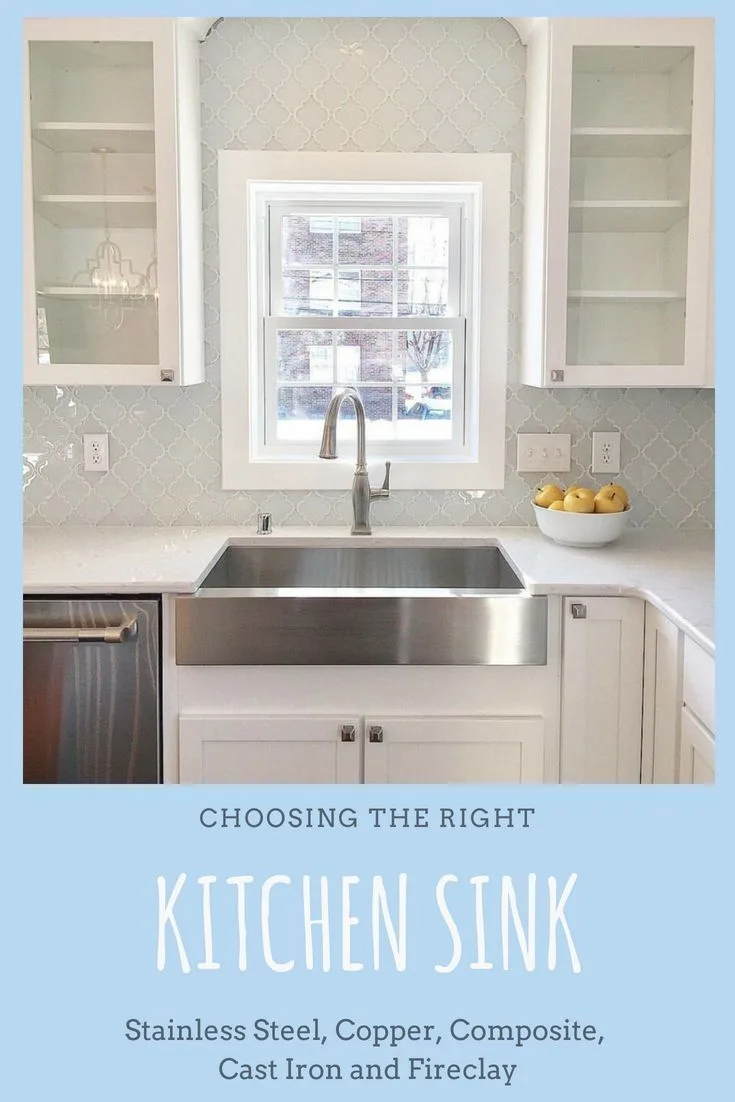
Single vs Double vs 1.5 Bowl: Which Layout Fits Your Cooking Style
Bowl configuration changes daily workflow more than most buyers expect.
Single Bowl
One large uninterrupted basin. Fits sheet pans, roasting trays, and stockpots flat. No divider to work around.
Best for serious cooks and small kitchens where every inch counts. Standard width 30 to 33 inches. Depth 9 to 10 inches.
Pair with a pull-down faucet for reach.
Double Bowl
Two equal basins side by side. Classic wash-and-rinse flow. Each bowl is narrower, typically 14 to 16 inches wide.
Large pots don't fit flat. Good for households that hand-wash and air-dry simultaneously. Requires 36-inch minimum cabinet per NKBA guidelines.
1.5 Bowl (Offset)
One large primary bowl plus a smaller secondary. The small bowl handles prep, rinsing, or disposal duty. Primary bowl stays wide enough for baking sheets.
Most versatile layout for mixed cooking styles. The offset drain in the big bowl improves stacking. Fits 33 to 36-inch cabinets.
Low-Divide Double
A double bowl with a center wall that stops halfway down. Combines single-bowl capacity for large items with two-zone functionality. Water splashes between sides.
Cleanup takes longer. Niche choice for specific workflows.
| Layout | Best For | Min Cabinet | Typical Width |
|---|---|---|---|
| Single | Large pots, small kitchens | 30″ | 30–33″ |
| Double | Hand-wash + rinse flow | 36″ | 33–36″ |
| 1.5 Bowl | Mixed cooking styles | 33″ | 33–36″ |
| Low-divide | Large items + two zones | 36″ | 36″ |
Gauge, Corners, Sound Pads, and Depth — The Specs That Change the Price
Spec sheet details separate a $250 sink from a $600 one. Know what you're buying.
Gauge (Stainless Only)
Lower number means thicker steel. 16-gauge is 0.0625 inches thick. 18-gauge is 0.05 inches. 20-gauge is 0.0375 inches. Thicker steel resists dents from heavy pots. It also dampens vibration naturally. 18-gauge hits the value sweet spot for most homes. 16-gauge adds $100 to $200. 20-gauge saves $50 but dents if you drop a cast iron skillet.
Corner Radius
Tight radius (R0 to R10) looks modern and adds usable bottom area. Harder to clean, food packs into the sharp angle. Standard radius (R15 to R19) wipes easily.
Generous radius (R25+) is the easiest to maintain but loses a little flat bottom space. R10 to R15 balances style and function.
Sound Dampening
Factory-applied rubber pads cover 30 to 50 percent of the bowl exterior. Thick undercoating adds mass. Together they cut the metallic ping by half.
Budget sinks skip both. Mid-range includes pads only. Premium adds heavy undercoating.
Tap the bowl in the showroom, a dull thud means good damping.
Bowl Depth
Standard 8 to 9 inches clears dinner plates. Deep 10 to 12 inches hides dirty dishes and fits sheet pans. ADA-compliant sinks max out at 6.5 inches for knee clearance.
Deeper bowls raise the drain outlet, check garbage disposal clearance. A 10-inch bowl with a disposal often needs a countertop at least 36 inches high.
Drain Placement
Center drain wastes usable stacking space. Rear drain pushes plumbing back and opens the full bowl floor. Offset drain splits the difference.
Match the drain location to your cabinet plumbing rough-in. Moving a drain line adds $300 to $800 to the project.
Faucet Hole Count
Zero-hole sinks let you mount the faucet on the counter or wall. One hole fits single-handle faucets. Two holes handle widespread sets.
Three holes cover widespread plus side spray or soap dispenser. Four holes add a filtered water tap. Drilling extra holes in stone costs $50 to $100 per hole.
Order the sink with the exact count you need.
Hidden Costs: Countertop Cutouts, Cabinet Mods, Faucet Holes, Disposal Clearance
The sink price on the product page is rarely the final number. These line items catch buyers off guard.
Countertop Cutout Timing
Fabricators cut the sink opening when they template the slab. If the sink hasn't arrived, they guess from a spec sheet. A 1/8-inch error ruins a $3,000 quartz top.
Order the sink first. Have it on site before the templating appointment. Some fabricators include one cutout in the slab price.
Others charge $100 to $300 per opening. Undermount cutouts cost more because they need polished edges.
Cabinet Floor Reinforcement
Fireclay, cast iron, and copper sinks weigh 100 to 200+ pounds. Standard particleboard cabinet floors deflect under that load. The sink rim then carries the weight and cracks the countertop seal.
Cut a 3/4-inch plywood panel to fit the cabinet floor. Screw it to the frame before setting the sink. Cost: $30 in materials, 30 minutes of labor.
Skip this and you risk a failed install within a year.
Faucet Hole Mismatch
You pick a single-handle faucet but the sink has three holes. Or you want a soap dispenser and filtered water tap but the sink only has two holes. Drilling quartz or granite after install runs $50 to $100 per hole.
Drilling stainless is easy, a step bit does it in seconds. Drilling fireclay or cast iron requires a diamond hole saw and patience. Match the hole count before you order.
Garbage Disposal Clearance
Deep bowls push the drain outlet lower. A 10-inch bowl with a 1/2-hp disposal often leaves less than 2 inches between the disposal bottom and the cabinet floor. The discharge elbow hits the floor.
Check the disposal spec sheet for "overall height from sink flange." Add the sink depth. Compare to your cabinet interior height minus 1 inch for the trap. If it's tight, choose a compact disposal or a shallower bowl.
Air Gap and Dishwasher Drain
Code in most jurisdictions requires an air gap or high-loop for the dishwasher drain. An air gap mounts on the countertop or sink deck, needs an extra hole. A high-loop runs inside the cabinet.
Either way, plan the plumbing route before the sink sits in silicone. Moving a supply line after the fact means cutting the countertop again.
| Hidden Cost | Typical Range | When It Applies |
|---|---|---|
| Countertop cutout | $100–$300 | New slab or undermount swap |
| Cabinet plywood | $30–$60 | Fireclay, cast iron, copper |
| Extra faucet holes | $50–$100 each | Stone countertops |
| Compact disposal | +$50–$100 | Deep bowl + standard cabinet |
| Air gap fitting | $20–$40 | Code requirement |
Price Tiers in 2024 Dollars: Budget, Mid-Range, Premium (Sink Only + Installed)
Real numbers help you set expectations before you walk into a showroom.
Budget Tier: $80–$350 Sink Only | $300–$650 Installed
Drop-in 20-gauge stainless. Single bowl or basic double. No sound pads.
Thin corners. Home center brands, Kraus, Zuhne, generic labels. Good for rental flips, laundry rooms, or a quick sale prep.
Lifespan 8 to 12 years. Install is DIY-friendly. Drop-in labor runs $150 to $250.
Mid-Range Tier: $350–$800 Sink Only | $600–$1,300 Installed
18-gauge stainless undermount with sound pads. Composite granite (Blanco Silgranit, Ruvati). Entry fireclay (Whitehaus, Barclay).
Cast iron enamel (Kohler standard lines). 16-gauge stainless at the top end. Sound damping included. R10 to R15 corners.
Rear or offset drains common. Pro install $250 to $500. This tier covers 70 percent of remodels.
Premium Tier: $800–$2,500+ Sink Only | $1,200–$3,000+ Installed
16-gauge stainless workstation systems (Kraus KWS, Ruvati RVH). Full-line fireclay (Shaw, Rohl). Copper hand-hammered (Native Trails, Sinkology).
Designer cast iron (Kohler Whitehaven, Franke). PVD-coated stainless colors. Tight-radius R0 corners.
Custom drain placements. Integrated accessories included. Install $400 to $700.
Cabinet mods often needed.
Installed Cost by Mount Type (Mid-Range Sink)
| Mount | Sink | Labor | Cutout | Total |
|---|---|---|---|---|
| Drop-in | $300 | $200 | $0* | $500 |
| Undermount | $400 | $400 | $200 | $1,000 |
| Farmhouse | $600 | $500 | $200 | $1,300 |
| Workstation | $550 | $450 | $200 | $1,200 |
*Existing cutout reused

Best Sink for Your Situation: Remodel, Rental, Heavy Cooking, ADA, Outdoor
Match the sink to the job. Don't overbuy or under-spec.
Full Kitchen Remodel
New cabinets, new countertops, new everything. You control the cabinet specs. Go undermount or farmhouse.
Pick 18-gauge stainless or composite for the best value-to-life ratio. Spec the cabinet base for a farmhouse if you want the look. Order the sink with the faucet holes you need.
Budget $1,000 to $1,500 total for a quality mid-range install.
Sink-Only Swap (Existing Countertop)
The cutout size locks your options. Measure the existing opening exactly. Drop-in sinks cover a range of cutout sizes, the rim hides gaps.
Undermount must match within 1/8 inch. If the cutout is oval or odd, you're stuck with drop-in. Budget $400 to $800 total.
Keep the faucet if the holes match.
Rental Property Refresh
Durability beats aesthetics. 18-gauge stainless drop-in resists tenant abuse. Sound pads reduce noise complaints. Rounded corners clean fast.
Avoid composite (chips), fireclay (cracks), copper (patina confuses tenants). Budget $300 to $500 installed. Expect 10 to 15 years.
Heavy Home Cooking / Canning
Single bowl, 10-inch depth, rear drain. 16-gauge stainless or composite. Workstation ledges hold colanders and cutting boards. You need space for stockpots and sheet pans.
Skip double bowls, the divider gets in the way. Budget $800 to $1,400 installed.
ADA / Aging-in-Place
Bowl depth max 6.5 inches per ADA. Knee clearance 27 inches high, 30 inches wide, 19 inches deep under the bowl. Rear drain keeps plumbing out of knee space.
Single lever faucet with pull-down spray. Shallow stainless or composite undermount. Budget $600 to $1,100 installed.
Outdoor Kitchen
316 marine-grade stainless only. 304 series pits near salt air or chlorine. Drop-in mount simplifies the countertop (concrete, tile, stone). No garbage disposal, grease clogs outdoor lines.
Single bowl, 9-inch depth. Budget $500 to $1,000 installed.
Common Buying Mistakes: Wrong Mount, Mismatched Faucet, Overlooking Weight
These errors cost money and time. They show up in return data and installer forums.
Ordering Undermount for Laminate Countertops
Undermount requires a solid, waterproof substrate. Laminate edges swell when water seeps under the rim. The bond fails.
The sink drops. Use drop-in only. If you want the undermount look on a budget, specify a solid-surface countertop, it costs less than stone.
Ignoring Cabinet Width Minimums
A 33-inch sink needs a 36-inch cabinet. A 30-inch sink needs a 33-inch cabinet. The extra 3 inches gives 1.5 inches per side for mounting clips and caulk.
Squeezing a 33-inch sink into a 33-inch cabinet leaves zero working room. The clips won't seat. The seal fails.
Measure the cabinet interior, not the door width.
Forgetting the Faucet Spread
Widespread faucets need 8 inches between outer holes. Centersets need 4 inches. Single-hole needs 1 hole.
The sink holes are fixed. The faucet is not. Buy the faucet first or confirm the spread matches.
Drilling stone after install is expensive. Drilling fireclay risks cracking the glaze.
Skipping Weight Check on Upper Cabinets
Farmhouse sinks hang from the cabinet face frame. Standard frames aren't rated for 150+ pounds. The face frame pulls away from the sides.
The countertop cracks. Use a retrofit support kit (metal rails that bolt to the cabinet sides) or order a farmhouse base cabinet rated for the load. Add $150 to $300.
Assuming All Stainless Is Magnetic
304 series is non-magnetic. 400 series is magnetic but less corrosion-resistant. A magnet test tells you nothing about quality. Look for "304" or "18/10" stamped on the bowl.
That's 18 percent chromium, 10 percent nickel. It's the standard for kitchen use.
Overlooking Disposal Flange Height
The disposal flange sits inside the drain opening. On deep bowls with thick composite or fireclay walls, the flange may not reach the disposal mount. You need an extended flange ($15 to $30) or a disposal with a longer neck.
Check the sink's drain throat thickness before buying the disposal.
Pro Installer Tips: Measure Twice, Template First, Seal Right
Installers see the same avoidable errors on every job. These habits save callbacks.
Use the Manufacturer Template, Not the Box Dimensions
Spec sheets list overall dimensions. The cutout template accounts for the mounting lip, clip clearance, and sealant bead. Cut to the template.
A 1/4-inch error on an undermount means the rim hits the countertop edge or leaves a gap. Templates are free on manufacturer sites. Print at 100 percent scale.
Verify with a ruler.
Dry-Fit Before Silicone
Set the sink in the cutout. Check clip engagement. Verify faucet hole alignment.
Confirm drain centerline matches the rough-in. On farmhouse sinks, check the reveal, the exposed front face should sit flush or slightly proud per the maker's spec. Adjust shims now.
Silicone cures in 20 minutes. You don't get a second try.
Clip Spacing Matters
Undermount clips go every 12 to 16 inches. More clips on the long sides. Fewer on the ends.
Tighten in a star pattern, opposite corners first. Overtightening bows the rim and breaks the seal. Snug is enough.
The epoxy does the heavy lifting.
Seal the Drain Flange with Plumber's Putty, Not Silicone
Putty stays pliable. Silicone hardens and cracks when the sink expands from hot water. Roll a rope of putty.
Press the flange down. Wipe excess from inside the bowl. Tighten the locknut from below.
The putty seal lasts decades.
Protect the Finish During Install
Stainless scratches from tool belts and clip screws. Tape the bowl interior with blue painter's tape. Lay a moving blanket in the sink while you work.
Composite and fireclay chip if a wrench slips. Copper dents from a dropped screwdriver. The finish is the product.
Treat it that way.
Test Drain Slope Before Final Caulk
Run water. Watch the drain. No standing water means the slope is right.
If water pools, the countertop isn't level or the sink settled. Adjust shims. Re-test.
Then run the final silicone bead around the rim. Smooth with a wet finger. Let cure 24 hours before use.
Maintenance Reality: What Each Material Demands Long-Term
A sink that looks great on day one can age poorly with the wrong care.
Stainless Steel
Rinse after each use. Chlorides from salt and cleaners pit the surface over time. Bar Keepers Friend removes heat tint and light scratches.
Always scrub with the grain. Avoid steel wool, it embeds iron particles that rust. Polish quarterly with a stainless protectant.
Hard water spots wipe away with vinegar.
Composite Granite / Quartz
Non-porous but not stain-proof. Coffee, tea, and turmeric leave marks if left overnight. Clean with dish soap and a soft cloth.
Avoid abrasive pads. Bleach dulls the finish. Use a composite-specific cleaner monthly (BlancoClean, Granite Gold).
Heat resistance is high but not infinite, use trivets for 500°F+ pans.
Fireclay
Glass-hard glaze resists almost everything. Clean with any non-abrasive cleaner. Baking soda paste lifts stubborn marks.
Never use metal scrubbers, they leave gray streaks that won't come out. Thermal shock is the real enemy. Don't pour boiling water into a cold bowl.
Run warm water first.
Cast Iron Enamel
Chips are permanent. The exposed iron rusts fast. Use a silicone mat for heavy pots.
Clean with dish soap or a mild abrasive like Bon Ami. Avoid drain cleaners, they etch the enamel. Touch-up kits exist for small chips but the color rarely matches perfectly.
Inspect annually.
Copper
Patina is a feature, not a flaw. If you want bright copper, wax monthly with beeswax or a copper protectant. Acidic foods (tomatoes, citrus) accelerate darkening.
Rinse immediately. Don't let standing water evaporate, mineral rings are hard to remove. Embrace the living finish or commit to the maintenance.
| Material | Daily Care | Deep Clean | Avoid | Refinish Possible |
|---|---|---|---|---|
| Stainless | Rinse, wipe dry | Bar Keepers Friend | Steel wool, bleach soak | Yes, professional |
| Composite | Soap, soft cloth | Brand cleaner | Abrasive pads, bleach | No |
| Fireclay | Soap, soft cloth | Baking soda paste | Metal scrubbers, thermal shock | No |
| Cast Iron | Soap, soft cloth | Bon Ami | Drain cleaners, heavy impact | Touch-up only |
| Copper | Rinse, wax monthly | Lemon+salt (bright) | Standing water, acid soak | Yes, re-wax |
Quick Decision Guide: Match Your Budget, Countertop, and Cooking Habits
Use this flowchart logic to narrow the field in five minutes.
Start with your countertop:
- Laminate, tile, wood → Drop-in only. Go 18-gauge stainless or composite.
- Granite, quartz, concrete, solid surface → Undermount, farmhouse, or workstation all work.
Pick your budget band:
- Under $500 total → Drop-in 18-gauge stainless. Single or 1.5 bowl.
- $500, $1,200 total → Undermount 18-gauge stainless or composite. 1.5 bowl or single deep.
- $1,200, $2,000 total → Farmhouse fireclay or composite. Workstation stainless. 16-gauge.
- Over $2,000 total → Copper, premium fireclay, designer cast iron, custom workstation.
Match your cooking:
- Large pots, sheet pans, canning → Single bowl, 10"+ depth, rear drain.
- Hand-wash + rinse flow → Double bowl or 1.5 bowl.
- Prep-heavy, small kitchen → Workstation with accessories.
- ADA needed → 6.5" max depth, single bowl, rear drain.
Check the cabinet:
- 30" wide → Single bowl drop-in or 30" undermount.
- 33" wide → 1.5 bowl or small farmhouse.
- 36"+ wide → Double bowl, large farmhouse, workstation.
Final gut check:
- Will you maintain it? Copper and fireclay need attention. Stainless and composite forgive neglect.
- Is the installer experienced with your mount? Farmhouse and undermount need a pro. Drop-in is DIY-friendly.
- Does the faucet match the holes? Confirm before you click buy.
You now have the data to pick a sink that fits the kitchen, the budget, and the way you actually cook.
Frequently Asked Questions
How much does a kitchen sink cost installed?
Most homeowners pay $600 to $1,300 for a mid-range sink with professional installation. Budget drop-in installs run $300 to $650. Premium farmhouse or workstation setups hit $2,000 to $3,000+.
Can I install an undermount sink myself?
Not recommended. Undermount requires precise epoxy bonding, clip alignment, and a polished countertop cutout. A 1/8-inch error leaks.
Pros charge $400 to $600 for this mount. DIY drop-in is realistic.
What gauge stainless steel is best for a kitchen sink?
18-gauge hits the value sweet spot. It resists dents, dampens noise with pads, and costs $100 to $200 less than 16-gauge. 20-gauge saves money but dents from heavy pots.
Do composite sinks chip easily?
They resist chips better than fireclay or cast iron. A dropped cast iron skillet may chip the corner. Normal use rarely damages them.
Avoid abrasive scrubbers to keep the finish intact.
Is a farmhouse sink worth the extra cost?
If you want the look and need deep capacity for sheet pans, yes. Budget $300 to $500 more than a comparable undermount for the sink plus custom cabinet base. Install labor runs higher too.
How long should a kitchen sink last?
Stainless 15 to 30 years. Composite 10 to 20 years. Fireclay 20 to 50 years.
Cast iron 20 to 30 years. Copper 50+ years. Maintenance and water quality affect actual lifespan.