How Much Does a Kitchen Remodel Really Cost?
How much does a kitchen remodel cost depends entirely on the variables you control and the ones you don't. National medians range from $28,000 for a minor refresh to $150,000-plus for an upscale gut. Your number lands somewhere in that gap based on scope, materials, labor market, and how many surprises hide behind the drywall.
Remodeling Magazine's 2024 Cost vs. Value report puts a major midrange remodel at $80,000 nationally with a 56 percent return at resale. That baseline shifts fast once you factor in your zip code and the decisions ahead.
Let's break down what actually drives the total.
Quick Answer
A minor cosmetic remodel averages $28,000. A major midrange gut averages $80,000. An upscale remodel exceeds $150,000.
Cabinets eat 25 to 35 percent of the budget. Labor runs 35 to 50 percent. Always carry a 20 percent contingency.
Why Kitchen Remodel Costs Vary So Wildly (And What Actually Drives Your Number)

Image source: Web (Bing) / gaylerdesignbuild.com (Web image (fair-use with source credit))
The spread between a $30,000 refresh and a $200,000 transformation comes down to five levers. Scope determines whether you keep the footprint or move walls. Cabinet tier sets the single largest line item.
Countertop material and fabrication complexity add thousands fast. Appliance packages range from builder-grade to pro-style. Labor rates swing 40 percent or more by metro area.
Each lever moves independently. A stock-cabinet kitchen with quartz counters in a low-cost market lands near $45,000. The same layout with custom cabinets and pro appliances in San Francisco hits $180,000.
Understanding each variable lets you build a budget that matches your reality.
The Five Variables That Decide Your Budget Tier

Image source: Web (Bing) / bestkitchenchoice.com (Web image (fair-use with source credit))
Scope tier comes first. Cosmetic means paint, hardware, lighting, maybe a backsplash. Partial gut replaces cabinets and counters but keeps walls.
Full gut strips to studs, reroutes plumbing and electrical, possibly moves a non-load-bearing wall. Layout change touches structure, requires engineering, triggers permits. Cabinet grade is the second lever.
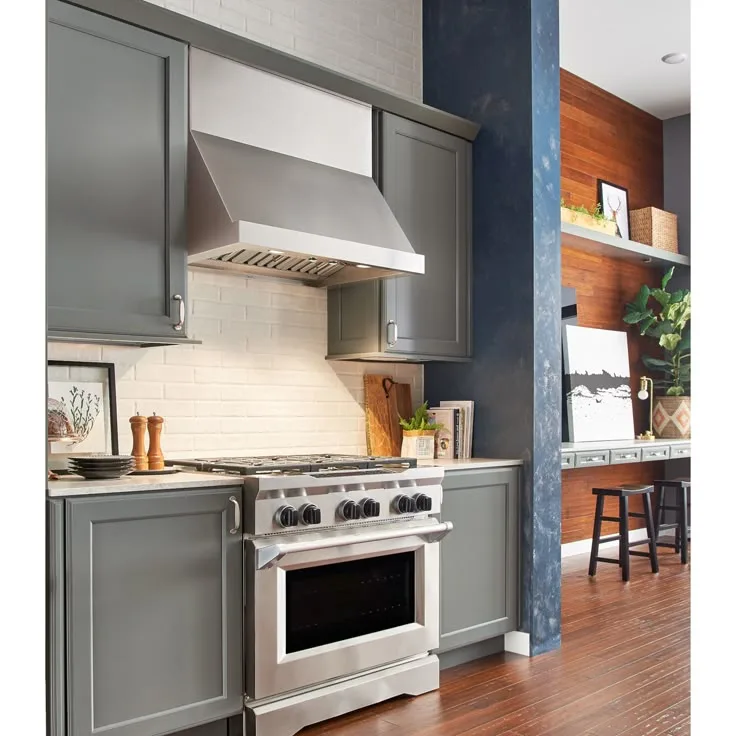
Stock boxes from big-box stores run $100 to $300 per linear foot. Semi-custom adds plywood construction, soft-close, deeper sizes at $200 to $500 per linear foot. Custom starts at $600 and climbs past $1,200.
Countertop material is third. Laminate installs around $40 per square foot. Quartz lands at $80 to $150.
Granite runs $70 to $200. Marble exceeds $200. Appliance package is fourth.
Builder-grade packages cost $5,000 to $8,000. Mid-range hits $12,000 to $20,000. Pro-style with integrated refrigeration pushes $35,000 to $60,000.
Labor market is fifth. A Midwest crew charges half what a coastal crew charges for the same work.
| Variable | Low End | Mid Range | High End |
|---|---|---|---|
| Scope | Cosmetic refresh | Full gut | Layout change + structural |
| Cabinets | Stock ($100–$300/LF) | Semi-custom ($200–$500/LF) | Custom ($600–$1,200+/LF) |
| Countertops | Laminate ($40/SF) | Quartz ($80–$150/SF) | Marble ($200+/SF) |
| Appliances | Builder ($5K–$8K) | Mid-range ($12K–$20K) | Pro-style ($35K–$60K) |
| Labor multiplier | 0.8x national | 1.0x national | 1.4x–1.8x national |
Scope First: Cosmetic Refresh vs. Partial Gut vs. Full Gut vs. Layout Change
Cosmetic refresh keeps every box in place. You paint cabinets, swap hardware, install a backsplash, maybe replace countertops and flooring. No permits needed unless you touch wiring or plumbing.
Typical range: $15,000 to $35,000. Partial gut removes cabinets, counters, flooring, sometimes soffits. You keep the footprint.
Plumbing and electrical stay roughly where they are. Typical range: $40,000 to $75,000. Full gut takes everything to studs.
You reroute supply lines, add circuits, move the sink, upgrade the panel. Permits required. Typical range: $70,000 to $130,000.
Layout change moves walls. If a wall is load-bearing, you need an engineered beam, new footings, special inspections. Adding or enlarging windows triggers egress review.
Typical range: $100,000 to $200,000-plus. The jump from partial to full gut often adds $30,000 just for mechanical work. The jump to layout change adds engineering fees and structural labor.
Cabinet Math: Stock, Semi-Custom, Custom — Real Cost Per Linear Foot

Image source: Web (Bing) / pinterest.com (Web image (fair-use with source credit))
Stock cabinets come in 3-inch increments. Boxes are particle board or thin plywood. Drawers are stapled.
Shelves are fixed. Finishes are limited. You get what fits.
Cost: $100 to $300 per linear foot installed. Semi-custom adds plywood boxes, dovetailed drawers, soft-close hinges, adjustable shelves, more door styles, depths up to 27 inches. You can modify widths in 1/16-inch increments.
Cost: $200 to $500 per linear foot installed. Custom means a cabinetmaker builds to your exact dimensions. Solid wood, any joinery, any finish, any interior organization.
No size limits. Cost: $600 to $1,200-plus per linear foot installed. A 20-linear-foot kitchen runs $2,000 to $6,000 for stock, $4,000 to $10,000 for semi-custom, $12,000 to $24,000 for custom.
The price gap is real. The durability gap is real too. Particle board swells if wet.
Plywood holds. Solid wood lasts generations. Decide based on how long you stay and what the neighborhood supports.
Countertop Reality Check: Material, Fabrication, and Hidden Add-Ons
Laminate is the budget play. Material costs $15 to $40 per square foot. Installation adds $25 to $40.
Seams show. Edges are limited. Heat resistance is low.
Quartz dominates the mid-range. Material runs $50 to $100 per square foot. Fabrication and install add $30 to $50.
Total $80 to $150 installed. No sealing needed. Consistent pattern.
Heat resistant to 300 degrees. Granite varies by slab. Material $40 to $100.
Fabrication $30 to $60. Sealing required annually. Natural variation means you pick the slab.
Marble is the luxury choice. Material $75 to $250. Fabrication $40 to $80.
Stains easily. Etches from acid. Patina develops.
Butcher block runs $40 to $100 installed. Needs monthly oiling. Can be sanded.
Hidden add-ons inflate every quote. Edge profiles: eased is free, ogee adds $10 to $20 per linear foot. Cutouts: each sink or cooktop cut adds $100 to $300.
Backsplash: full-height slab backsplash doubles the slab order. Radius corners, waterfall ends, mitered edges, each adds labor hours. Get a line-item fabrication quote before you commit.
Appliance Packages: Builder-Grade to Pro-Style — What You're Actually Paying For
Builder-grade packages include a freestanding range, basic dishwasher, over-the-range microwave, and top-freezer refrigerator. Expect $5,000 to $8,000 for the set. Finishes are white, black, or fingerprint-resistant stainless.
Features are minimal. Warranty is one year. Mid-range steps up to slide-in ranges, quiet dishwashers at 44 decibels, counter-depth refrigerators, and convection ovens.
Prices run $12,000 to $20,000. You get better insulation, stronger racks, smarter cycles. Pro-style mimics commercial gear.
Ranges hit 18,000 to 25,000 BTU burners. Refrigerators are fully integrated with panel-ready doors. Dishwashers use stainless tubs and third racks.
Ventilation demands 600 to 1,200 CFM hoods with make-up air. Packages start at $35,000 and clear $60,000 with dual-fuel ranges and wine columns. The jump from mid-range to pro buys performance you only use if you cook heavily.
Resale data shows buyers rarely pay back pro-style premiums. Match the package to your actual cooking and your neighborhood ceiling.
| Tier | Range Style | Dishwasher dB | Fridge Type | Typical Package |
|---|---|---|---|---|
| Builder | Freestanding coil | 55+ | Top-freezer | $5K–$8K |
| Mid-range | Slide-in gas | 44–48 | Counter-depth French door | $12K–$20K |
| Pro-style | Dual-fuel pro range | 38–42 | Integrated panel-ready | $35K–$60K+ |
Labor & Location: Why Your Zip Code Changes the Bottom Line 40%
Labor runs 35 to 50 percent of total cost. A crew in Kansas City charges $65 to $85 per hour for a carpenter. The same crew in Seattle bills $110 to $140.
Electricians swing from $80 to $150. Plumbers from $90 to $180. General contractor markup adds 15 to 25 percent on top of subs.
High-cost metros also carry higher permit fees, disposal costs, and parking logistics. Seasonal demand shifts pricing 10 to 15 percent. Winter starts often get better bids.
Summer books fast at premium rates. Rural areas save on labor but pay more for material delivery and sub travel. Always get three local bids.
Compare line items not just bottom lines. A low bid often misses line items that appear later as change orders.
The Permit & Structural Trap: When "Simple" Becomes Expensive
Moving a sink three feet triggers a plumbing permit. Adding a circuit triggers electrical. Removing a wall triggers structural review if it bears load.
Permit fees range $500 to $3,000 depending on municipality. Plan review takes two to six weeks. Inspections add scheduling delays.
Load-bearing removal requires an engineer stamp ($1,500 to $3,000), a beam calculation, footing verification, and a special inspection. Adding a window or door touches egress codes and energy compliance. Historic districts add design review boards and material matching rules.
HOA approvals can stall starts by 30 to 60 days. Always confirm permit scope before signing a contract. A "simple" gut that opens walls often reveals knob-and-tube wiring or undersized gas lines.
Those become mandatory upgrades at your expense. Budget for the worst-case reveal.
Building a Real Budget: Line Items, Contingency, and the 20% Rule
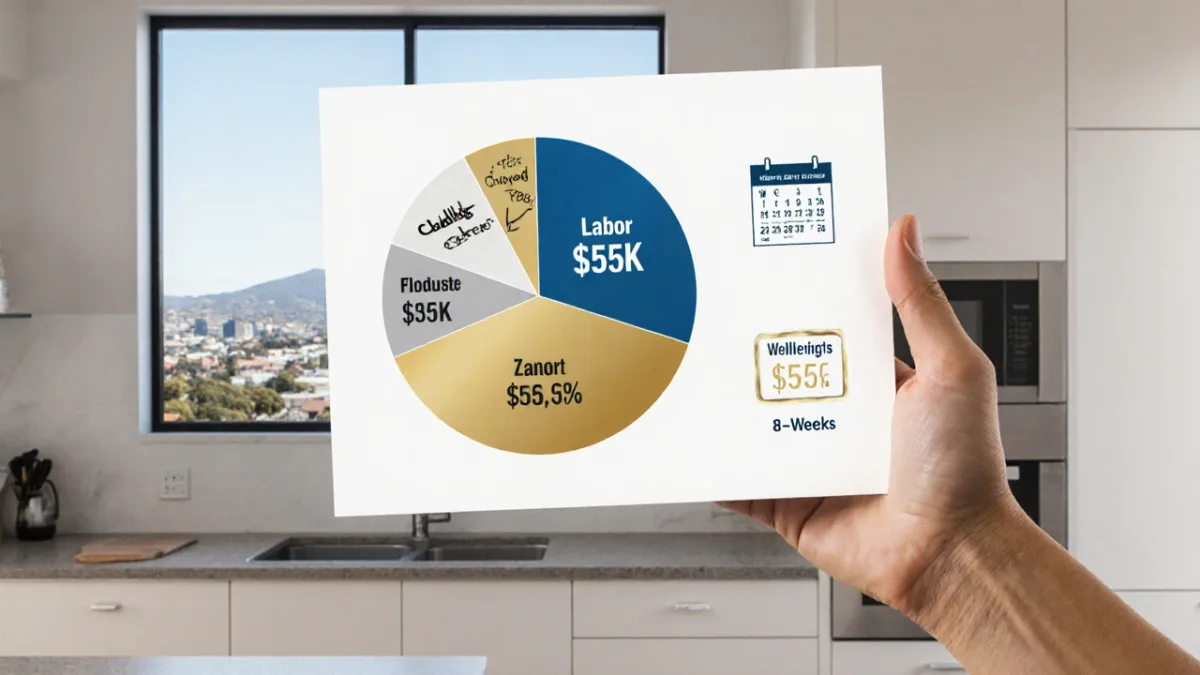
Image source: Web (Bing) / garagedoorservicesltd.co.uk (Web image (fair-use with source credit))
Start with a spreadsheet. List every category: design fees, permits, demo, framing, plumbing rough, electrical rough, HVAC, insulation, drywall, paint, trim, cabinets, countertops, backsplash, flooring, appliances, lighting, hardware, ventilation, final clean. Assign a researched cost to each.
Use local supplier quotes not national averages. Add a 20 percent contingency on the subtotal. Do not treat contingency as upgrade money.
It covers rotted subfloors, asbestos abatement, code upgrades, and measurement errors. If you finish under, you keep the difference. Track actuals weekly.
Move money between lines only with written change orders. A typical $80,000 midrange budget breaks down roughly: cabinets $20,000, labor $28,000, countertops $6,000, appliances $12,000, flooring $4,000, plumbing fixtures $3,000, electrical fixtures $2,500, paint and trim $3,500, contingency $16,000. Adjust percentages to your scope.
Phased vs. All-at-Once: Cash Flow, Timeline, and Design Cohesion
Phasing spreads cost over months or years. Phase one might be paint, hardware, lighting, and backsplash. Phase two replaces counters and flooring.
Phase three tackles cabinets and layout. Total spend stays the same but cash flow eases. Risks add up.
Disruption repeats. Design cohesion suffers if selections drift. Contractors charge mobilization fees each return.
Material prices rise between phases. Tile dye lots change. Cabinet lines discontinue.
All-at-once delivers a single timeline, one mobilization, cohesive design, and often a volume discount. Typical full gut runs six to twelve weeks construction. Phased stretches to six to eighteen months.
If you phase, finalize all selections upfront. Order long-lead items together. Store them properly.
Hire the same crew for each phase. Get a master schedule before day one.
Design-Build vs. Bid-Build vs. Owner-Managed: Who Owns the Risk?
Design-build puts one entity on the hook for design and construction. Single contract. Single point of accountability.
Change orders still happen but the finger-pointing stops. Typical fee: 10 to 15 percent of construction cost. Best for complex projects where you want schedule certainty.
Bid-build separates design from construction. You hire a designer or architect first. Produce permit-ready drawings.
Then bid to three GCs. Lowest qualified bid often wins. You own the coordination risk.
Designer errors become your change orders. GC claims drawings are incomplete. Best for simple scopes with clear plans.
Owner-managed means you hire and schedule every sub yourself. You save GC markup (15 to 25 percent). You buy all the scheduling headaches.
Permit pulls. Inspection coordination. Material deliveries.
Sub no-shows. Lien waivers. Only viable if you have construction experience and time.
Most lenders require a licensed GC for renovation loans.
| Model | Who Manages Subs | Fee Structure | Risk Owner | Best For |
|---|---|---|---|---|
| Design-build | Single firm | 10–15% of build | Firm | Complex, tight timeline |
| Bid-build | GC (you hire designer) | GC markup 15–25% | You (design gaps) | Simple, clear scope |
| Owner-managed | You | No GC markup | You entirely | Experienced owners only |
Common Budget Killers: Change Orders, Lead Times, and "While We're At It"
Change orders average 10 to 15 percent of contract value. Most stem from design changes after cabinet order locks. Moving a sink six inches after rough-in costs $1,500 to $3,000.
Adding a pot filler after drywall costs double. Lead times kill schedules. Semi-custom cabinets run 8 to 12 weeks.
Quartz slabs 3 to 6 weeks. Specialty tile 6 to 10 weeks. Appliance backorders stretch to 16 weeks.
One late item stalls the whole crew. "While we're at it" adds up fast. Since the floor is up, replace the subfloor.
Since the wall is open, add recessed lighting. Since the painter is here, do the adjacent hallway. Each add-on carries mobilization and sequencing costs.
Track every request in writing. Price it before work starts. Say no to anything not in the original scope unless you have contingency left.
Your Decision Framework: Match Scope, Finish, and Risk Tolerance to a Real Number
Start with your stay horizon. Ten-plus years: invest in layout, custom storage, durable finishes. Two to five years: neutral mid-range, keep footprint, maximize ROI.
Flip: cosmetic only, broad appeal, speed. Next, set a hard ceiling. Pull your home's current value.
Cap total project at 10 to 15 percent of value for midrange. Upscale caps at 5 to 8 percent. Then walk the decision tree.
If layout works and boxes are sound, refacing saves 40 percent over replacement. If counters are the only eyesore, quartz overlay costs half of full slab. If appliances run fine, keep them and allocate budget to cabinets.
If you hate the flow, budget for full gut plus structural. Match each choice to your risk tolerance. Low tolerance: design-build, fixed-price contract, 20 percent contingency.
Medium: bid-build with detailed specs, 15 percent contingency. High: owner-managed, time-and-materials, 10 percent contingency (you absorb overruns). Run your numbers through the framework before you call a designer.
Frequently Asked Questions
How much does a minor kitchen remodel cost?
A minor cosmetic remodel averages $28,000 nationally. It includes paint, hardware, lighting, backsplash, and sometimes countertop replacement without layout changes.
What is the biggest cost driver in a kitchen remodel?
Cabinets typically consume 25 to 35 percent of the total budget. Cabinet tier (stock, semi-custom, custom) is the single largest lever on final cost.
Should I include a contingency in my kitchen remodel budget?
Yes. Carry a 20 percent contingency on the subtotal. It covers hidden conditions like rotted subfloors, outdated wiring, and code-required upgrades discovered during demo.
How long does a full kitchen gut remodel take?
Construction runs 6 to 12 weeks for a full gut. Add 2 to 3 months for design, selections, permitting, and material lead times before demo starts.
Does a kitchen remodel increase home value?
A midrange major remodel recoups about 56 percent at resale per Remodeling Magazine. Minor remodels recoup 70 to 80 percent. Upscale remodels recoup 40 to 50 percent.
Can I finance a kitchen remodel with a renovation loan?
Yes. FHA 203k and Fannie Mae HomeStyle loans bundle purchase or refinance plus renovation costs into one mortgage. They require a licensed GC and detailed contractor bids.