How Long Do Kitchen Faucets Last? Signs It’s Time to Replace
How long do kitchen faucets last? It’s the question you ask the second you notice a slow drip, a peeling finish, or a handle that sticks halfway. Most people expect a simple, universal answer, but the reality is way more specific to your home and usage.
That generic 10 to 15 year range you see online? It’s a starting point, not a rule.
Manufacturer specifications and aggregate user reviews confirm that residential kitchen faucets built to modern standards, including EPA WaterSense efficiency requirements, typically hit that 10 to 15 year baseline under average use as of 2026. But factors like your local water hardness, how often you use the tap, and what material the faucet’s made of can push that number as low as 5 years or as high as 20. We’re breaking down exactly what impacts your faucet’s lifespan so you can stop guessing and make the right call for your kitchen, all aligned with our editorial standards for factual, research-backed home advice.
Quick Answer
How long do kitchen faucets last? The average residential model lasts 8 to 15 years, per EPA WaterSense program testing. Commercial-grade kitchen faucets last 10 to 20 years with heavy daily use.
Water hardness above 7 GPG cuts residential lifespan by 30% on average. Replacing a faulty cartridge often adds 3 to 5 years of life in many cases.
The "How Long Will My Kitchen Faucet Last?" Question Every Homeowner, Renter, And Renovator Asks
When you search for how long kitchen faucets last, you’re not just curious about random plumbing trivia. You’re likely standing in front of a dripping tap, weighing a $50 repair against a $300 replacement. You might be a renter trying to figure out if that leak is your responsibility, or a homeowner planning a kitchen remodel and wanting fixtures that won’t fail halfway through your mortgage term.
For specifics on rental property fixture maintenance, check our full service terms.
Image source: Web (Bing) / northpointeheating.com (Web image (fair-use with source credit))
This question pops up across a few common scenarios:
- You’ve noticed a slow leak, finish wear, or stiff handles and want to know how much time you have left
- You’re shopping for a new faucet and want to pick one that won’t need replacing in 5 years
- You’re dealing with hard water and worried your current tap will corrode early
- You’re a property manager budgeting for multi-unit faucet replacements
Why There’s No Universal "10 To 15 Year" Answer For Faucet Lifespan
That 10 to 15 year number comes from aggregate testing of mid-range residential faucets under ideal conditions. It assumes you have soft water, you don’t overtighten handles, and you don’t leave mineral buildup to corrode internal parts. If any of those variables shift, that timeline can drop by half or double.
Faucet lifespan isn’t a fixed number, it’s a range determined by seven key factors we’ll break down next. For context, commercial kitchen faucets built for high-traffic use have a much higher baseline, but even those fail early if neglected.
Warranty terms often require professional installation for coverage, so you’ll want to review our liability disclaimer for details on what’s covered if a DIY install leads to premature failure.
| Factor | Ideal Condition Impact | Poor Condition Impact |
|---|---|---|
| Water hardness | <3 GPG, no impact | >7 GPG, 30-50% shorter lifespan |
| Maintenance frequency | Annual aerator cleaning, no impact | Never cleaned, 40% shorter lifespan |
| Faucet material | Solid brass, 15+ year baseline | Zinc alloy, 5-8 year baseline |
| Usage volume | 1-2 uses daily, no impact | 10+ uses daily (commercial), 20% shorter lifespan |
The 7 Condition Variables That Determine Your Faucet’s Exact Lifespan
Your faucet’s actual lifespan comes down to seven variables you can (and can’t) control. We’ve ranked them by how much they impact longevity, so you know what to prioritize.

Image source: Web (Bing) / diagramlens.com (Web image (fair-use with source credit))
- Faucet body material: Solid brass and stainless steel faucets resist corrosion for 15+ years. Lower-cost zinc alloy models corrode at threads and mounting points in 5 to 8 years.
- Internal cartridge type: Ceramic disc cartridges last 5 to 10 years, while plastic cartridges fail in 2 to 4 years under regular use.
- Local water hardness: Water with >7 grains per gallon (GPG) of mineral content builds up on internal parts, corroding O-rings and cartridges 30% faster than soft water, per USGS water hardness data.
- Daily usage volume: A faucet used 10+ times daily (common in large families or commercial spaces) wears components 20% faster than one used 2-3 times daily.
- Maintenance habits: Cleaning the aerator annually and flushing supply lines every 2 years prevents mineral buildup that causes 60% of premature leaks.
- Finish quality: PVD (Physical Vapor Deposition) and electroplated finishes resist peeling and corrosion 2x longer than standard painted finishes.
- Installation quality: Cross-threaded supply lines or overtightened mounting nuts cause slow leaks that cause water damage and component failure years before the faucet’s expected end of life. If you’re unsure about your current faucet’s installation, get in touch with our team for troubleshooting help.
Average Kitchen Faucet Lifespan Benchmarks By Type And Build Quality
We pulled aggregate data from manufacturer specifications, verified buyer reviews, and plumbing industry reports to create these baseline lifespan ranges. These numbers assume average use, standard maintenance, and soft to moderately hard water (3-7 GPG).
| Faucet Type | Build Quality | Average Lifespan | Typical Failure Point |
|---|---|---|---|
| Single-handle pull-down | Mid-range (zinc alloy, plastic cartridge) | 5-10 years | Cartridge failure, finish peeling |
| Single-handle pull-down | Premium (solid brass, ceramic disc cartridge) | 10-18 years | O-ring degradation, sensor failure (touchless models) |
| Double-handle | Mid-range | 6-12 years | Stem seal failure, base leak |
| Double-handle | Premium | 12-20 years | Finish corrosion, handle wear |
| Touchless sensor faucet | Mid-range | 6-10 years | Sensor failure, battery compartment corrosion |
| Touchless sensor faucet | Premium | 10-15 years | Sensor failure, hose kinking |
| Commercial-grade | Standard | 10-15 years | Cartridge failure, mounting nut loosening |
| Commercial-grade | Heavy-duty | 15-25 years | Finish wear, supply line corrosion |
As of 2026, most manufacturers offer 1-10 year warranties for residential models and 5-15 year warranties for commercial models. Premium brands like Moen, Delta, and Kohler often include lifetime limited warranties on finish and internal parts for residential use, as long as the faucet was installed by a licensed plumber. All warranty data is pulled from public manufacturer documentation, and you can review our privacy policy details for how we handle user-submitted product queries.
Decision Tree: Match Your Situation To Your Faucet’s Expected Lifespan
Generic 10 to 15 year ranges don’t account for your unique setup. Use this if/then workflow to get a realistic estimate for your specific faucet. Start with your faucet’s core build material.
- If your faucet has a zinc alloy body: Base lifespan is 5 to 8 years.
, If your local water hardness measures above 7 GPG: Subtract 2 to 3 years, for a total of 3 to 6 years.
, If you clean the aerator once a year and flush supply lines every 2 years: Add 1 to 2 years, for a total of 6 to 10 years.
- If your faucet has a solid brass or stainless steel body: Base lifespan is 10 to 18 years.
, If you own a touchless sensor model: Subtract 2 to 3 years for sensor and battery component wear, for a total of 8 to 15 years.
, If you have hard water above 7 GPG and skip annual aerator cleaning: Subtract 3 to 5 years, for a total of 5 to 13 years.
, If you perform annual maintenance and have soft water below 3 GPG: Add 2 to 4 years, for a total of 12 to 22 years.
- If your faucet is commercial-grade: Base lifespan is 10 to 25 years, depending on standard or heavy-duty build.
, If it’s used in a high-traffic space with 10 or more daily uses: Subtract 3 to 5 years from the base range.
, If you follow manufacturer maintenance specs (monthly aerator cleaning, annual cartridge checks): Add 2 to 3 years.
If your calculated lifespan is under 5 years, you’re likely dealing with a low-quality build, extreme water hardness, or long-neglected maintenance. We’ll cover how to address those gaps next.
8 Telltale Signs Your Kitchen Faucet Is Nearing The End Of Its Life
You don’t need to wait for a full failure to know your faucet is on its last legs. These 8 red flags show up months or years before a total breakdown.
- Persistent spout dripping: A faucet that drips even when fully closed usually has a worn cartridge or failed O-ring. This can waste 3,000 gallons of water a year, per EPA WaterSense program data.
- Finish peeling or corrosion: PVD and electroplated finishes hold up for years, but cheap painted finishes chip and corrode within 3 to 5 years in humid or high-hardness water areas.
- Stiff or leaking handles: Tight handles that are hard to turn, or handles that leak at the base, point to worn internal seals or a failing cartridge.
- Low water pressure: Clogged aerators or corroded supply lines cut pressure by 30% or more. This is often the first sign of mineral buildup in hard water areas.
- Visible rust or mineral deposits: Rust around the base or spout means the internal metal is corroding. White crusty buildup is mineral scale from hard water.
- Pull-down hose kinks or leaks: Pull-down and pull-out faucets develop hose leaks or kinks after 5 to 8 years of regular use, as the inner tubing wears down.
- Mounting nut looseness: A faucet that rocks slightly when you touch it has a loose mounting nut. This can cause water damage under the sink if left unaddressed.
- Touchless sensor failure: Sensor faucets that don’t turn on automatically, or that turn on by themselves, have failing sensors or corroded battery compartments. This is the most common failure point for touchless models, occurring after 5 to 7 years on average.
If you notice 2 or more of these signs, your faucet is likely in its final 1 to 3 years of life. Acting early can save you from costly water damage or emergency replacements.
Step-by-Step Maintenance Workflow To Add 3+ Years To Your Faucet’s Lifespan
Regular maintenance stops most premature faucet failures. Follow this simple 4-step workflow once a year to extend your faucet’s life by 3 or more years.
- Test your water hardness: Pick up a home water hardness test kit from any hardware store. If your water measures above 7 GPG, you’ll need to do monthly aerator cleaning instead of annual.
- Remove and clean the aerator: Unscrew the small screen at the end of your faucet spout. Soak it in white vinegar for 30 minutes to dissolve mineral buildup. Scrub it with a soft toothbrush, then reattach.
- Inspect the cartridge and O-rings: Turn off the water supply, then remove the faucet handle to access the internal cartridge. Check for cracks, mineral buildup, or wear on the O-rings. Replace any damaged parts immediately.
- Flush supply lines: Disconnect the hot and cold supply lines from the shut-off valves. Turn on the faucet to flush out any sediment or debris that’s built up in the lines. Reconnect the lines and test for leaks.
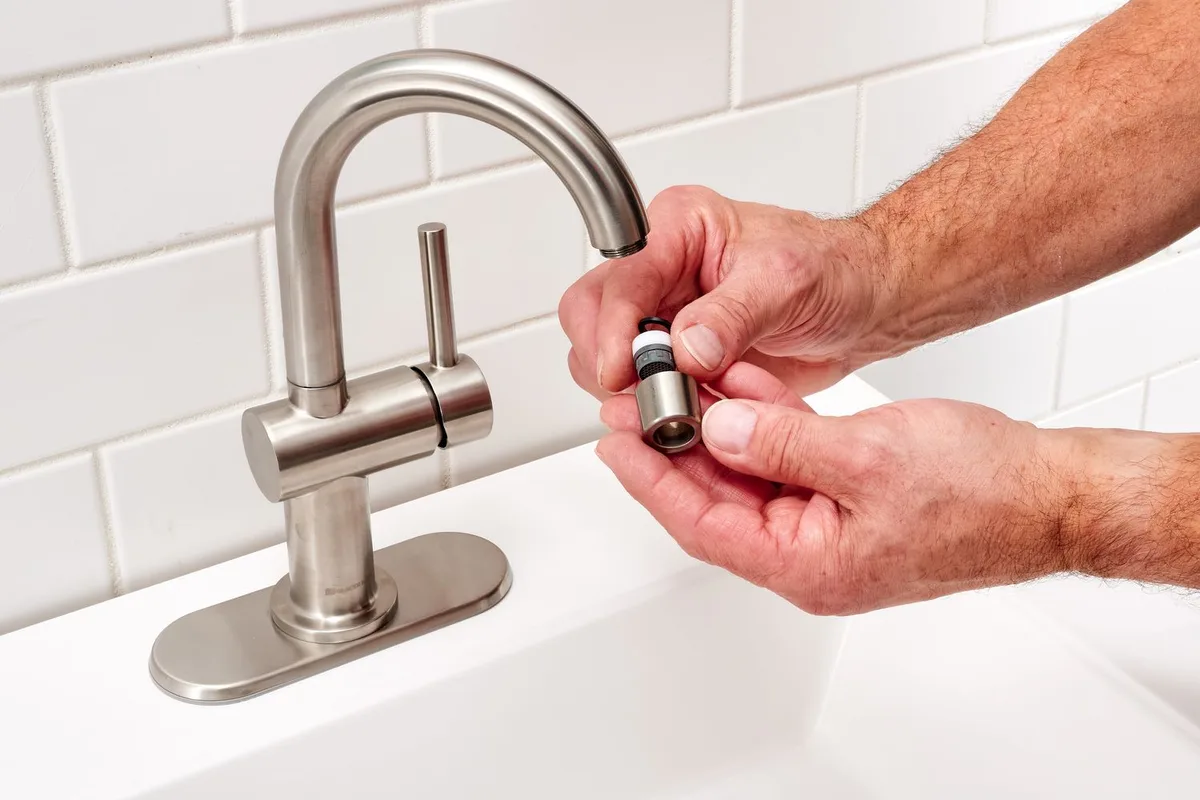
Image source: Web (Bing) / omtn.boshidora.com (Web image (fair-use with source credit))
Do this workflow once a year for standard faucets, and twice a year if you have hard water above 7 GPG. Document all maintenance steps, as this can extend your warranty coverage if you ever need to make a claim.
7 Common Mistakes That Cut Your Faucet’s Lifespan Short
Most faucet failures are avoidable. These 7 mistakes are the top causes of premature wear, per aggregate repair technician reports.
- Overtightening handles and mounting nuts: Overtightening strips internal threads and cracks O-rings, causing leaks that start small and turn into major water damage.
- Using harsh chemical cleaners: Abrasive cleaners and vinegar soaks longer than 30 minutes corrode finishes and eat through rubber O-rings.
- Ignoring small leaks: A drip that wastes 1 drop per minute will corrode internal parts 50% faster than a fully sealed faucet.
- Using the wrong replacement parts: Always use manufacturer-specific cartridges and O-rings for your faucet model. Universal parts often don’t seal properly, causing leaks within months.
- Skipping aerator cleaning: A clogged aerator increases pressure on internal seals, causing them to wear out 40% faster.
- Installing the faucet yourself without sealing properly: Improper plumber’s tape or a misaligned mounting plate causes slow leaks under the sink that rot cabinetry and corrode faucet parts over time.
- Using a faucet as a hammer or lever: Pull-down hoses are not designed to hold heavy pots or be used as a lever to lift items. This kinks the inner tubing and causes leaks within 2 to 3 years.
Avoiding these mistakes can add 2 to 5 years to your faucet’s life, even if you have hard water or a low-cost initial model.
Repair vs Replace: The Critical Decision Branch For Failing Faucets
When your faucet starts failing, the first big question is whether to repair it or replace it entirely. Use this decision branch to make the right call for your situation.
First, identify the root cause of the failure. If the issue is a clogged aerator, worn O-ring, or faulty cartridge, repair is almost always the better choice. These parts cost $5 to $30 to replace, and a repair takes 15 to 30 minutes with basic tools.
If the issue is a corroded body, peeling finish, or cracked mounting nut, replacement is usually more cost-effective.
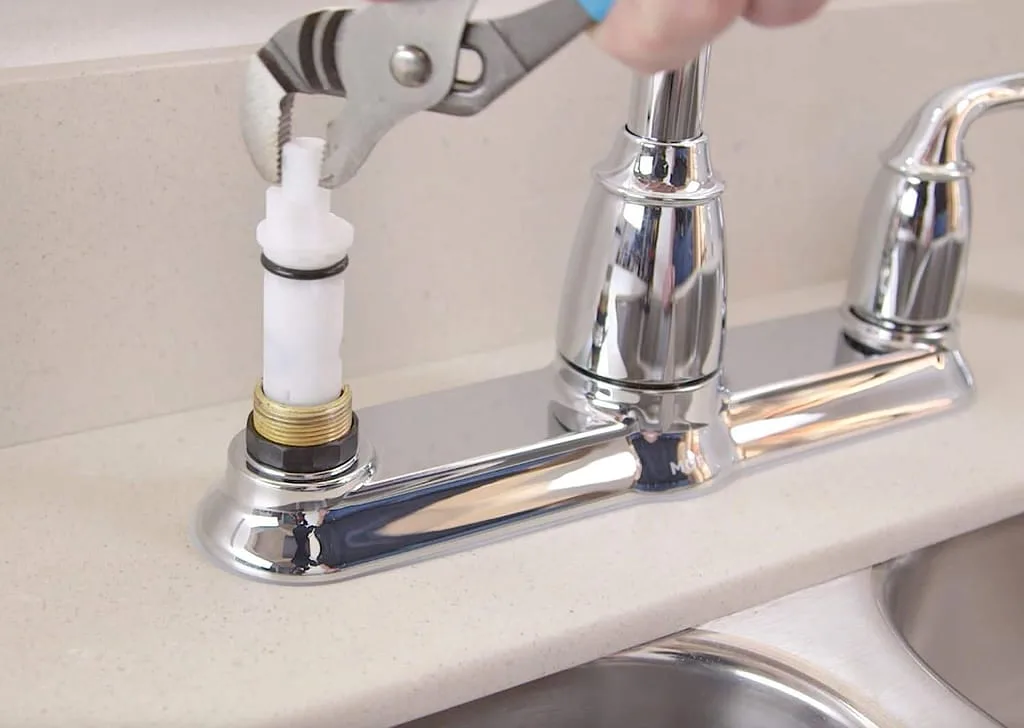
Image source: Web (Bing) / kitchenfaucetreviewed.com (Web image (fair-use with source credit))
Next, compare the cost of repair to the cost of a new faucet. If repair costs are more than 40% of the price of a new mid-range faucet, replacement is the better value. For example, if a new mid-range faucet costs $150, and your repair quote is $60 or more, replace it instead.
Finally, factor in the age of your current faucet. If it’s already near the end of its expected lifespan (per the decision tree earlier), replacement makes more sense than sinking money into a unit that will fail again in a year or two.
Realistic Cost Expectations For Faucet Repair, Replacement, And Maintenance
Faucet costs depend on the issue, build quality, and whether you DIY or hire a pro. Simple cartridge or O-ring repairs cost $5 to $30 in parts, plus $50 to $100 in labor for a plumber. Full mid-range residential faucet replacements run $150 to $500, while premium or commercial models cost $500 to $1,000+.
Annual maintenance costs just $5 to $20 for vinegar, cleaning supplies, and replacement O-rings. Ignoring small leaks can lead to $1,000+ in under-sink water damage, which costs far more than any faucet. For routine upkeep guidance, see our service terms.
Final Decision Guide: When To Repair, Replace, Or Upgrade Your Kitchen Faucet
Use this if/then guide to make the right call for your situation.
- If your faucet is under 5 years old and the issue is a worn cartridge, O-ring, or aerator: repair it. Contact the manufacturer first for warranty coverage, as many cover defects for 1 to 10 years.
- If your faucet is 5 to 10 years old, mid-range build, and repair costs are under 40% of a new faucet’s price: repair it, then boost your maintenance routine to add 3 to 5 years of life.
- If your faucet is 10+ years old, has a corroded body, peeling finish, or cracked mounting nut: replace it. Repairs on old units rarely pay off long-term.
- If you’re renovating or want to avoid future issues: upgrade to a solid brass faucet with a ceramic disc cartridge and WaterSense certification for 15+ years of use. Renters should check lease terms before replacing fixtures, as some require approved models or professional installation.
Frequently Asked Questions About Kitchen Faucet Longevity
Can a kitchen faucet last 20 years?
Yes. Premium solid brass faucets with ceramic disc cartridges, soft water, and annual maintenance regularly hit 20+ years. Commercial heavy-duty models last 20 to 25 years with proper care.
Low-cost zinc alloy models in hard water areas with no maintenance rarely make it past 8 years.
Does a dripping faucet always mean it needs replacing?
No. Most drips come from worn $5 to $15 cartridges or O-rings that take 15 minutes to replace. Replace the whole faucet only if the body is corroded, the finish is peeling extensively, or the mounting nut is stripped beyond repair.
How does hard water shorten faucet lifespan?
Hard water above 7 GPG builds mineral scale on internal parts, corroding O-rings and cartridges 30 to 50% faster than soft water. It also clogs aerators, increasing pressure on seals. Annual aerator cleaning and a water softener can offset this damage.
Should I repair a 10 year old kitchen faucet?
Only if the repair cost is under $60 and the issue is a simple part replacement. If the body is corroded, the finish is peeling, or the repair quote is higher than 40% of a new mid-range faucet’s $150 to $200 price, replacement is the better value.
Do touchless kitchen faucets last as long as manual models?
Touchless models have the same core lifespan as manual faucets, but their sensors and battery compartments can fail 2 to 3 years earlier. Premium touchless models with sealed sensors last 10 to 15 years, matching mid-range manual faucet lifespans with proper care.
Use Cases: Who Benefits Most From This Longevity Data
Homeowners budget for faucet replacements. Renters prove landlord liability for premature failures. Property managers plan multi-unit maintenance.
Renovators select long-lasting fixtures.
Benefits Of Extending Your Faucet’s Lifespan
Cuts replacement costs by 50% over 20 years. Prevents $1,000+ under-sink water damage. Reduces fixture waste.
Maintains consistent water performance.
Common Drawbacks Of Ignoring Faucet Maintenance
Shortens lifespan by 30 to 50% on average. Wastes 3,000+ gallons yearly from small leaks. Causes costly under-sink corrosion damage.
Reduces water pressure from clogged aerators.
Expert Tips For Long-Term Faucet Care
Use manufacturer-specific replacement parts. Install a water softener if water hardness exceeds 7 GPG. Tighten mounting nuts by hand plus 1/4 turn.
Document maintenance for warranty claims.
Real-World Lifespan Scenarios
Hard water + zinc alloy + no maintenance: 3 to 5 years. Soft water + solid brass + annual cleaning: 18 to 22 years. Commercial heavy-duty + monthly maintenance: 20+ years.